This document is a practical roadmap for how the EU medicines network intends to strengthen data interoperability, analytics, and AI-enabled regulatory capabilities, with annual updates planned. For pharmaceutical companies, it signals where regulators are investing: DARWIN EU (RWE), more systematic clinical study data analytics, AI governance and tools, and interoperability standards aligned with EHDS.
Notably, the workplan outlines the following focus areas and deliverables:
A clear long-term vision: “Trusted medicines by unlocking the value of data”, with an explicit commitment to using data within an ethical framework and in compliance with EU data legislation.
A structured program across six workstreams: Strategy & governance; Data analytics; Artificial intelligence; Data interoperability; Stakeholder engagement & change management; Guidance & international initiatives.
Alignment with major EU initiatives impacting data exchange and evidence generation, including European Health Data Space (EHDS/TEHDAS2), revised EU pharmaceutical legislation, IDMP-related work (UNIWIDE IDMP), and broader interoperability frameworks.
Scaling Real-World Evidence via DARWIN EU, including onboarding data partners, executing studies, and planning further expansion (DARWIN EU 2).
Transitioning clinical study data activities from pilots toward systematic submission and analysis of patient-level clinical study data for centrally authorised products (CAPs), supported by tools/process updates and training.
An AI workstream that includes: publishing Guiding Principles for Good AI Practice, an AI glossary, annual AI Observatory updates, AI literacy training (linked to AI Act obligations), and deployment of internal AI tools (e.g., Scientific Explorer, SPC Reader/SPC Search, AI assistants) supported by an AI Tools Framework.
Interoperability deliverables such as data catalogues/metadata management, defined data roles (e.g., trustees/stewards), and a medicines-regulation data glossary—explicitly linked to EHDS readiness.
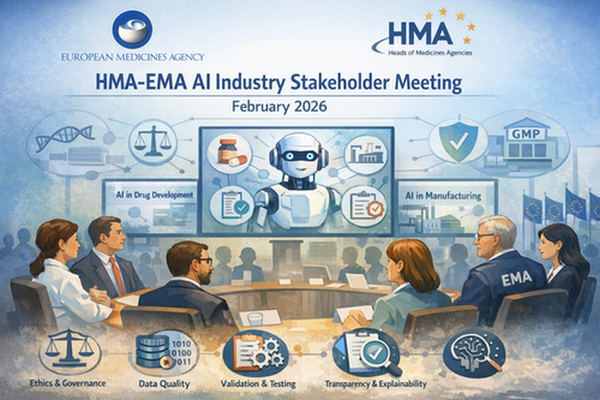
EMA has published the event page and supporting documents for the HMA–EMA AI group meeting with industry stakeholders (February 2026) and subsequently posted summary notes. This is a concrete regulatory mechanism for aligning expectations on acceptable AI use, governance, and evidence—also in areas that can impact GMP/CMC and lifecycle data.
Notably, the current guidance development activities mentioned include:
Guidance on AI in clinical development (a concept paper is expected before a full draft guideline).
Guidance on AI in pharmacovigilance, to be developed jointly with PRAC as a Q&A-style document.
EU GMP Annex 22 on AI in manufacturing: following public consultation (≈1,300 comments received), it is now under revision, with the final document expected by the end of the year.
Several industry interventions were noted, including an expectation for a more flexible approach to the use of AI in GMP. This includes the potential use of generative AI and large language models (LLMs) in critical GMP applications, provided this is supported by a robust, risk-based framework.
FDA deploys internal generative-AI tooling to speed scientific reviews (“Elsa”) + agency-wide rollout
FDA launched / expanded a generative AI tool to accelerate scientific reviews and related tasks; Reuters describes intended uses and rollout context.
FDA also issued its own announcement about completing an AI-assisted review pilot and scaling AI internally.
Why it matters for pharma: This affects how fast and how consistently regulators can process submissions, identify issues, and target inspections. Even if Elsa is “internal,” it changes the regulatory interface pharma works with.