A recent Pharmaceutical Technology article discusses how digital standards can modernise pharmaceutical quality assurance without compromising confidence. This follows the launch of USP MethodConnect, a machine-readable library of USP-NF test methods designed for integration into LIMS, LES and ELN systems.
This may look like a laboratory informatics topic, but it is highly relevant to AI in pharma. AI and automation depend on reliable, structured and controlled data. If compendial methods are manually retyped from PDF or paper into laboratory systems, there is a risk of transcription errors, inconsistent interpretation and weak traceability.
Machine-readable standards reduce that risk by allowing trusted quality requirements to be integrated directly into digital laboratory workflows. This creates a stronger foundation for automation, advanced analytics and future AI-supported QC processes.
Why this matters for pharma and GMP:
AI-ready laboratories need structured, trusted and machine-readable quality data.
Manual transcription of compendial methods into digital systems creates compliance risk.
Digital standards can improve traceability, version control and consistency.
Machine-readable methods can support LIMS, LES, ELN and automated review workflows.
Trusted digital standards may help AI systems remain anchored to approved scientific and compendial sources.
Practical takeaway:
For QC laboratories, AI readiness is not only about buying AI software. It is also about building a controlled digital foundation.
Companies should assess:
how compendial methods are transferred into laboratory systems;
how method versions are controlled;
whether manual transcription creates data integrity risks;
whether LIMS, LES, ELN and CDS systems can use structured method content;
how future AI tools will access controlled and approved source information;
whether digital standards can reduce ambiguity during method execution, review and inspection.
The long-term message is important: reliable AI in QC will depend on reliable digital standards. If the source content is controlled, machine-readable and traceable, AI-supported workflows become easier to justify and govern.
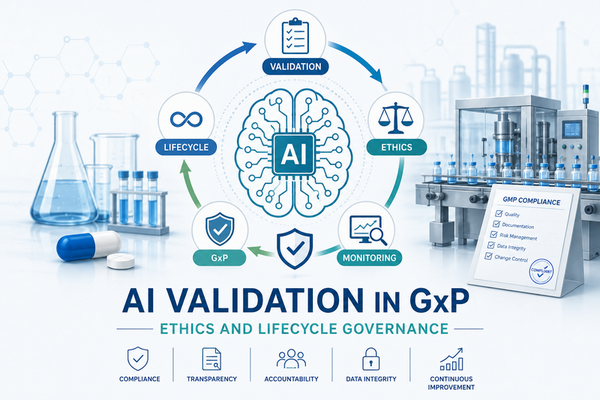
A new open-access review published in AI and Ethics discusses validation, ethics and lifecycle governance of AI and machine learning in GxP applications.
This is one of the most relevant recent publications for GMP and pharma quality teams because it directly addresses the gap between high-level AI principles and practical implementation in regulated environments.
The paper compares regulatory approaches from FDA, EMA and the EU AI Act, including expectations related to AI in GxP, the draft EU GMP Annex 22, FDA’s AI credibility framework, data integrity, validation, lifecycle management, human oversight and generative AI risks.
The authors propose an Integrated Validation, Ethics and Lifecycle framework, called IVEL. The framework is not presented as an official standard, but as a structured way to organize AI validation and governance activities across the lifecycle.
Why this matters for pharma and GMP:
AI validation cannot be treated as a one-time software test.
AI systems require defined intended use, risk assessment, data governance, performance qualification, lifecycle monitoring and change control.
Generative AI creates specific risks, including hallucination, prompt sensitivity, factual inconsistency and unclear reproducibility.
AI outputs used in GxP decisions must remain traceable to data, model version, system configuration and human review.
The paper reinforces that AI systems should be governed within the pharmaceutical quality system when they influence regulated processes.
Practical takeaway:
Pharmaceutical companies should start converting AI governance principles into practical SOPs and validation templates. For each AI use case, companies should define the context of use, risk level, data sources, model versioning approach, human review process, performance monitoring plan and requalification triggers.
This paper is especially useful for teams preparing internal AI policies, AI validation approaches, Annex 22 readiness plans or AI risk-assessment templates.
A 2026 Frontiers paper (European perspective) is highly relevant to pharma quality teams because it focuses on LLMs for process automation and compliance work (SOP automation, audit documentation, deviation management, compliance monitoring) and explicitly discusses the EU regulatory context (MDR/GDPR/EU AI Act). It also highlights the evaluation gap (lots of “accuracy-only” studies; little real-world deployment evidence) and argues for validation approaches that acknowledge non-determinism.
EMA published a short FAQ describing “Scientific Explorer,” an AI-enabled search tool used by the EU regulatory network to find regulatory precedents. The pharma-relevant part is the transparency: EMA describes it as information retrieval, not “AI generating new decisions,” and gives concrete validation metrics (F1 score range) plus hosting/governance details (secure EU cloud; no training new models on EMA data).
EMA and the Heads of Medicines Agencies released their annual “AI Observatory” report, which is effectively a regulatory horizon scan of where AI is already showing up in submissions, regulator operations, and EU-funded regulatory science. A key value of this report is that it doesn’t just talk about AI—it documents where regulators see real activity and where the gaps remain (notably: “regulatory-grade” model validation and auditability).