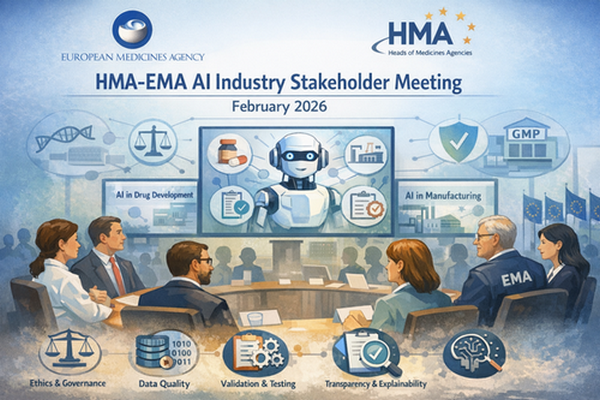
EMA has published the event page and supporting documents for the HMA–EMA AI group meeting with industry stakeholders (February 2026) and subsequently posted summary notes. This is a concrete regulatory mechanism for aligning expectations on acceptable AI use, governance, and evidence—also in areas that can impact GMP/CMC and lifecycle data.
Notably, the current guidance development activities mentioned include:
Guidance on AI in clinical development (a concept paper is expected before a full draft guideline).
Guidance on AI in pharmacovigilance, to be developed jointly with PRAC as a Q&A-style document.
EU GMP Annex 22 on AI in manufacturing: following public consultation (≈1,300 comments received), it is now under revision, with the final document expected by the end of the year.
Several industry interventions were noted, including an expectation for a more flexible approach to the use of AI in GMP. This includes the potential use of generative AI and large language models (LLMs) in critical GMP applications, provided this is supported by a robust, risk-based framework.
FDA deploys internal generative-AI tooling to speed scientific reviews (“Elsa”) + agency-wide rollout
FDA launched / expanded a generative AI tool to accelerate scientific reviews and related tasks; Reuters describes intended uses and rollout context.
FDA also issued its own announcement about completing an AI-assisted review pilot and scaling AI internally.
Why it matters for pharma: This affects how fast and how consistently regulators can process submissions, identify issues, and target inspections. Even if Elsa is “internal,” it changes the regulatory interface pharma works with.
Key AI GMP-relevant documents where regulators explicitly address AI / ML or the core compliance expectations that govern AI used in manufacturing (computerized systems, validation/assurance, data integrity, lifecycle control) are listed below with relevant links
Disclaimer:
Last review and links update : 2026-08-31, note: links to draft documents may stop working after the consultation phase ends.
The documents listed below have different regulatory status. Some are binding requirements, while others are guidance, discussion papers, or draft documents under consultation or revision.
FDA (US) — AI in pharma manufacturing & quality
• Artificial Intelligence in Drug Manufacturing (Discussion Paper, 2023) — FDA CDER discussion paper focused on AI use in drug manufacturing (not guidance, but important signal of expectations). https://www.fda.gov/ … edia/165743/download - It also includes many other useful links.
• Considerations for the Use of AI to Support Regulatory Decision-Making for Drug and Biological Products (Draft Guidance, Jan 2025) — FDA risk-based credibility assessment framework for AI models used to support regulatory decisions regarding safety, effectiveness or quality. The framework is based on the model’s specific Context of Use (COU). https://www.fda.gov/ … -drug-and-biological
• Guiding Principles of Good AI Practice in Drug Development (Jan 2026) — FDA + EMA aligned principles; explicitly spans lifecycle including manufacturing. https://www.fda.gov/ … edia/189581/download
• FDA “Artificial Intelligence for Drug Development” hub page (collects the above + related FDA AI resources). https://www.fda.gov/ … nce-drug-development
GMP/quality foundations that apply to AI systems
• Data Integrity and Compliance With Drug CGMP: Q&A (Dec 2018) — the core FDA data integrity expectations that AI systems must meet (ALCOA+, audit trail, controls, governance). https://www.fda.gov/ … uestions-and-answers
• PAT — A Framework for Innovative Pharmaceutical Development, Manufacturing and Quality Assurance (Guidance; PDF) — not “AI”, but foundational for model-based control/monitoring and advanced analytics in manufacturing. https://www.fda.gov/media/71012/download
• Process Validation: General Principles and Practices (Guidance; PDF) — validation lifecycle principles that also govern AI-enabled control/monitoring when it impacts product quality. https://www.fda.gov/ … es-and-Practices.pdf
• Emerging Technology Program (ETP) (CDER) — FDA program supporting innovative manufacturing technologies (relevant pathway when AI is part of novel manufacturing control/automation). https://www.fda.gov/ … chnology-program-etp
• Advanced Manufacturing Technologies (AMT) Designation Program (Final Guidance, Dec 2024) — FDA programme supporting early adoption of advanced manufacturing technologies. Relevant where AI/ML forms part of a novel manufacturing or control technology. https://www.fda.gov/ … -designation-program
EMA / EU medicines regulators — AI + EU GMP updates
• EMA Reflection paper on the use of AI in the medicinal product lifecycle (final, 9 Sept 2024; PDF) — covers principles across lifecycle and regulatory expectations when AI outputs are used in regulated submissions (incl. manufacturing-related evidence). https://www.ema.euro … uct-lifecycle_en.pdf
• Network Data Steering Group Workplan 2026–2028: Data and Artificial Intelligence in Medicines Regulation (Version 2.0, Feb 2026) — current HMA–EMA strategic workplan for the use of data and AI in medicines regulation. It includes development of AI guidance for clinical development and pharmacovigilance, regulatory AI tools, data standards and coordinated AI implementation across the European medicines regulatory network. https://www.ema.euro … -steering-group-ndsg
• EMA/FDA: Guiding principles of good AI practice in drug development (Jan 2026; PDF) — joint high-level principles (explicitly spanning manufacturing).https://www.ema.euro … g-development_en.pdf
EU GMP (EudraLex Volume 4) — Computerised Systems and Artificial Intelligence
• EU GMP Annex 11: Computerised Systems (current) — the core existing GMP framework applicable to computerised systems, including AI-enabled systems used in GMP processes.
• Revision of Chapter 4, Annex 11 and New Annex 22 – Artificial Intelligence (draft) — the European Commission consultation closed on 7 October 2025. Annex 22 remains under development and is not currently an effective GMP requirement.
• Draft Annex 22: Artificial Intelligence — proposes GMP expectations covering intended use, model selection and training, performance metrics, independent test data, validation, operation, change control, performance monitoring and human review.
Status: EMA Annex 22 Multistakeholder Expert Workshop, 30 June–1 July 2026 — EMA collected additional expert evidence to support further development of Annex 22, including discussion of GenAI/LLMs, guardrails, human oversight, lifecycle monitoring, cybersecurity and outsourced/cloud AI.
• EU Artificial Intelligence Act – Regulation (EU) 2024/1689 — binding horizontal EU legislation governing AI systems. It is not a GMP regulation, but pharmaceutical companies may need to consider its requirements in parallel with sector-specific GxP requirements depending on the AI system, its intended purpose and the organisation’s role in the AI value chain.
• PIC/S PI 041-1: Good Practices for Data Management and Integrity in regulated GMP/GDP environments (final; PDF) — widely relied upon by inspectorates; very relevant for AI data pipelines and governance. https://picscheme.org/docview/4234
• PIC/S PI 011-3: Good Practices for Computerised Systems in Regulated “GxP” Environments (PDF) — inspector-oriented expectations for computerised systems (validation, supplier management, control). https://picscheme.org/docview/3444
• PIC/S PI 006-4: Recommendations on Qualification and Validation (published 30 Jul 2026; effective 1 Oct 2026) — revised PIC/S recommendations covering qualification and validation lifecycle principles. Not AI-specific, but an important supporting framework when AI-enabled technologies form part of qualified equipment, validated processes or GMP systems. https://picscheme.org/docview/11277
UK MHRA
• Use of AI for GxP Inspection Responses: Setting Standards Without Stifling Innovation (MHRA Inspectorate, 29 Jun 2026) — important practical regulatory position based on actual inspection experience. MHRA reported AI-assisted inspection responses containing non-existent regulatory references and materially inaccurate information. The regulator emphasises human verification, organisational accountability and effective CAPA rather than generic AI-generated responses. https://mhrainspecto … stifling-innovation/
• MHRA GxP Data Integrity Guidance and Definitions (Rev. 1, March 2018; PDF) — strong practical expectations for data integrity controls that apply directly to AI toolchains. https://assets.publi … rch_edited_Final.pdf
Health Canada
• Annex 11 (GUI-0050): Computerized Systems — Health Canada adoption of Annex 11 principles for GMP computerized systems (useful for “regulatory convergence” arguments). https://www.canada.c … ystems-gui-0050.html
Artificial Intelligence (AI) has the potential to transform the way medicines are developed and evaluated, ultimately improving healthcare outcomes. In this context, the EMA and FDA issued joint guidance in January of this year outlining 10 international guiding principles. These principles identify areas where international regulators, standards organizations, and other collaborative bodies can work together to advance good practices in drug development.
Areas of collaboration include research, the development of educational tools and resources, international harmonization, and the establishment of consensus standards. These efforts may help inform regulatory policies and guidelines across different jurisdictions, in alignment with applicable legal and regulatory frameworks.
Further details can be found in the relevant documents (links below). However, the 10 guiding principles are particularly worth highlighting: 1. Human-centric by design
The development and use of AI technologies align with ethical and human-centric values. 2. Risk-based approach
The development and use of AI technologies follow a risk-based approach with proportionate validation, risk mitigation, and oversight based on the context of use and determined model risk. 3. Adherence to standards
AI technologies adhere to relevant legal, ethical, technical, scientific, cybersecurity, and regulatory standards, including Good Practices (GxP). 4. Clear context of use
AI technologies have a well-defined context of use (role and scope for why it is being used). 1 For the purpose of this document, the term “drug” is used to refer to drugs and biological products as defined in the United States of America, and medicinal products as defined in the European Union. 5. Multidisciplinary expertise
Multidisciplinary expertise covering both the AI technology and its context of use are integrated throughout the technology’s life cycle. 6. Data governance and documentation
Data source provenance, processing steps, and analytical decisions are documented in a detailed, traceable, and verifiable manner, in line with GxP requirements. Appropriate governance, including privacy and protection for sensitive data, is maintained throughout the technology’s life cycle. 7. Model design and development practices
The development of AI technologies follows best practices in model and system design and software engineering and leverages data that is fit-for-use, considering interpretability, explainability, and predictive performance. Good model and system development promotes transparency, reliability, generalizability, and robustness for AI technologies contributing to patient safety. 8. Risk-based performance assessment
Risk-based performance assessments evaluate the complete system including human-AI interactions, using fit-for-use data and metrics appropriate for the intended context of use, supported by validation of predictive performance through appropriately designed testing and evaluation methods. 9. Life cycle management
Risk-based quality management systems are implemented throughout the AI technologies’ life cycles, including to support capturing, assessing, and addressing issues. The AI technologies undergo scheduled monitoring and periodic re-evaluation to ensure adequate performance (e.g., to address data drift). 10. Clear, essential information
Plain language is used to present clear, accessible, and contextually relevant information to the intended audience, including users and patients, regarding the AI technology’s context of use, performance, limitations, underlying data, updates, and interpretability or explainability
(EU)
‘AI system’ means a machine-based system that is designed to operate with varying levels of autonomy and that may exhibit adaptiveness after deployment, and that, for explicit or implicit objectives, infers, from the input it receives, how to generate outputs such as predictions, content, recommendations, or decisions that can influence physical or virtual environments;
Source: EU Regulation 2024/1689
***
(US / FDA) A machine-based system that can, for a given set of human-defined objectives, make predictions, recommendations, or decisions influencing real or virtual environments. Artificial intelligence systems use machine- and human-based inputs to perceive real and virtual environments; abstract such perceptions into models through analysis in an automated manner; and use model inference to formulate options for information or action.