This report (written with input from 100+ independent experts across many countries and organisations) synthesises what frontier/general-purpose AI systems can do, what risks they pose, and how those risks can be managed. For pharma companies deploying GenAI/LLMs (quality, PV, medical writing, knowledge systems), it is a practical reference for “known failure modes” (evaluation gaps, reliability issues, misuse risks) and governance expectations.
International AI Safety Report 2026: what matters for pharma (quick take)
The International AI Safety Report 2026 (Feb 2026) is not a pharma-specific guidance, but it contains several points that are highly relevant for pharmaceutical companies using GenAI/LLMs or “AI agents” in R&D, labs, medical information, PV, quality systems, and regulated documentation.
Notably, the report highlights the following pharma-relevant themes:
- AI as a scientific accelerator (with dual-use implications). Advanced AI can support tasks such as molecule/protein design and other scientific work that can accelerate drug discovery, while also raising dual-use concerns (bio/chem misuse risk).
- Growing capability of AI agents in laboratory contexts. The report discusses increasingly capable agents (“AI co-scientists”) that can assist with experimental protocols, troubleshooting, and interacting with biological tools—useful for legitimate research but also relevant for risk governance.
- Use of “benign proxy tasks” in bio/chem risk evaluation. Because direct weapons testing is constrained, the report notes that safer proxy tasks—explicitly including activities like pharmaceutical synthesis—are used to estimate how much AI can increase capability.
- The “evaluation gap” as a central governance warning. Models can look strong in benchmarks but behave differently in real-world settings. For pharma, this directly supports the need for realistic testing, monitoring, and lifecycle control before relying on AI outputs in high-stakes processes.
- Reliability risks in high-stakes domains like medicine. The report highlights known failure modes (e.g., hallucinations/out-of-distribution failures) and notes that these issues matter in medical contexts, reinforcing the need for boundaries and human oversight.
- Safety practices that map well to pharma governance. The report emphasizes practices such as red-teaming and monitoring/control approaches, which align well with regulated “fit-for-intended-use” thinking and ongoing oversight.
Practical takeaway: this report strengthens the argument that GenAI and agentic systems should be treated as probabilistic tools with real failure modes—requiring realistic evaluation, red-teaming, monitoring, and clear boundaries, especially when outputs influence regulated decisions.
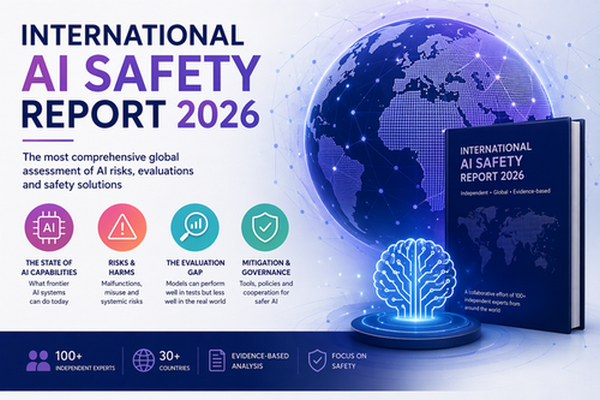
Publication page: https://internationa … i-safety-report-2026
Direct PDF: https://internationa … fety-report-2026.pdf